

I. Graduation
This story begins at the very end, in a courtyard which I have since walked past countless times on my way to other places. For the 2024 graduates of the University of Manchester, the atmosphere was one of suspended disbelief: No one could believe that it was over. The job market was about to crash in anticipation of the arrival of fourth-generation GPTs. Yet hope was in the air. And so we all went along, and rode the thrilling waves of boundless optimism until some semblance of reality reasserted itself.
Financial Times published a piece describing the “ghost bankers of Wall Street” who felt unable to move on from their previous vocation. These individuals might not have even necessarily enjoyed the work, but decades of gruel had clearly made branded thralls of once hopeful graduates. What had already begun to take shape in that tiny little courtyard, full of laughter and mutual congratulations, was the unsettling thought that the labours of education, after being ceaselessly celebrated and enshrined in certificates, remain outstanding, still to be reckoned with, made sense of. To all of us who went to university, we have all “done our time.” This time could mean a great many different things to a great many different people. To me though, the whole saga could not have been more clearly distilled than in the one and only comment my supervisor made to my mom about who I once was within these hallowed halls of learning:
“He’s very hardworking. The other peer mentors? They were all rubbish. But he was brilliant.”
Defiant till the end.

II. Loops
The thoughts or feelings that I was somehow trapped in a recurring pattern of behaviour which constituted my life as an undergraduate in university only took on a phantasmagoric sheen upon graduation. Like how I still structure notes as if I am building a case, or feel the urge to debate my coworkers, an entire way of life impinges upon the way I still carry on living. And the past never feels more present than during these surreal moments when its Object is no longer the future, but a perennial present.
It is to one very specific instance of this temporal loop that I now turn my attention to – a structure I will for now designate as “receiving a familiar sensation I got whenever I received a disappointing mark“.
Immediately, it can be said that this thematisation is overdetermined, in the sense that what being a university student is about could have nothing to do at all with the previous living of the university life. There are many events which might trigger this familiar sensation, the university could have nothing to do with the triggering. Indeed, from one perspective an existence is nothing more than a bundle of exercised/actualised capacities. It would then be a simple phenomenological continua in which a 3-year period appears as an interval. But if I follow Husserl and insist that the binding or the unity of my existence is always carried out with interest, then there is no reason why any part of this totality can be phenomenologically left out. After all, this totality which is my existence is precisely the unity of its constituting parts. Looking back on the many posts I made about “bad essay feedback,” and still occasionally finding myself avoiding or lashing out against situations which remind me too much of my time in university (book clubs, debates, intellectual conversations in general), I believe this specific sensation, and its thematisation as being about my memories of the university, are not in the slightest essential, but nevertheless worth exploring.
But the more general point is this:
By engaging with thoughts or feelings on a structural level, I arrived at findings which I believe have broader socio-ethical implications. Whether or not this is valid I will leave to you to decide. For now, a recollection.
My first essay at the university was to answer the question “Is language innate?” This was supposed to be a cumulation of four weeks of learning as we traversed the uneven terrain of psycholinguistics and encountered views such as nativism, behaviourism and universal grammar. By the point I started writing I had read so much more than what was required that I was practically bloated with confidence. As the only philosophy student in my class, I was viewed as an object of some curiosity by my fellow classmates. I would get comments about the way I spoke, “abstract” was a word that came up time and time again. I did not make much of it at the time. I was simply enjoying the unexpected attention that I was receiving, and there was a girl in my class who seemed to be constantly struggling with the weekly reading. Explaining the same to her became my way of clarifying my own understanding. All things considered, I believed I was on track to harvesting my first, first-class essay.
Then judgment day arrived, and I discovered that I got a barely passing grade. 53/100 to be precise. Meanwhile the girl whom I had been assist-learning with for the past four weeks was all up and down with joy as she showed off to everyone her unprecedented 76/100.
“Well done,” the tutor nodded in approval. “Keep it up.”
But what did the feedback actually say? Turned out all the quirks which had earmarked me for attention during class were real, codified reasons why the essay was “difficult to follow,” “too argumentative,” and “not definitive enough in its position.” The mark itself was a sobering reminder that being unique has consequences, and not all kinds of attention should be taken at face value. The gulf between my own appraisal of my abilities, and how it came across in an assignment, could be one too wide for the mind to be able to bridge. I could not comprehend, as the assessor clearly could not comprehend my essay, how this could have happened. I did not find the justifications for the marking helpful in the slightest because it was never the controversial thing, to say that an obtuse, poorly structured essay is also not a very good one; the sting came from the identity judgment which had been made – The essay which I wrote was one such essay.
In New Right Students?: exploring high achieving British university students’ discourse of learning, Joyce E. Canaan conducted interviews with two of her students in trying to gauge members of a particular generation’s attitudes towards their own education. The goal of these interviews was to potentially detect traces of New Right ideology in the way these students talked about themselves and their peers. As for what this ideology is, here is Canaan’s own summary:
“During [the period between the 1960s and the 1990s] the burgeoning New Right encouraged a movement towards corporate welfare, where government funds were increasingly allocated to the growing minority of entrepreneurs and private businesses that could accumulate capital.”
p.751, Canaan (2004)
The description reminds me of Yanis Varoufakis’ pithy phrase “Welfare for the companies. Austerity for the poor.” And it is a holistic orientation towards the total installation and upkeep of a managerial structure which is designed or constructed for the maximisation of some as-yet-specified value. The trap is believing that all structures are intentionally represented as profit-maximising, which is often not true when it comes to universities. Situations may arise where by maximising some auxiliary value, this can in turn serve as a proxy for the maximisation of profits in the long run. An educational institution would want to be associated with a brand of longtermism which is as far removed as possible from the money-grabbing world of fast food, fast fashion and fast appliances. Troiani and Dutson (2021) described this beautifully in architectural terms:
“In order to reimage and rebrand themselves in their physical form, many UK universities undertook or are in the process of undertaking ambitious real-estate developments including opening up overseas campuses, and expanding national property portfolios with new buildings in which can be found an excess of ‘spaces for collaboration,’ ‘vibrant meeting points’ and multicoloured, office-style soft furniture.”
p.6, Troiani and Dutson (2021)
The fantasy which is being sold, is a breezy, Silicon-Valley adjacent narrative about aspirational dreamers who actualise their individual geniuses through the co-production of “world-changing” technologies. In fact during a night out for pizzas along Oxford Road with my second-year housemates, this was the exact idea exclaimed by one of them as rows upon rows of modernist glass outcrops sprang up around us –
Look at all this space!
Imagine all the groundbreaking discoveries that are being made as we live and breath!
What a wonderful time to be alive!
What becomes phenomenologically salient in this edufactory, which is also what Canaan so wonderfully captured, are the specific beliefs held by students which also came to motorise the operations of such an institution. Recall that production of intellectual technologies in this factory is total. That is every member, from the chancellor, to the gardener, must come together – in everything they do, thinking included – to make the university a better place. This means actors often subscribe in their conscious beliefs to a normativity which elides its real object, the thing behind the better. Individual beliefs must always fit the managerial culture of the edufactory, render it ever-more legible, ever-easier to oversee, and ever-more efficient in its functioning. Beliefs associated with assignments and essay feedbacks are but a microcosm of this. Let us now examine these more closely, beginning with the two interviewees in Canaan (2004).
Both of them “believed that innate ability and motivation enabled one to succeed in education” (p.754, Ibid.). Amongst them Rebecca “presumed that those most engaged in multiple learning activities with high ability should get the highest marks, those less engaged in learning with high ability should get lower marks and those least engaged in learning should get still lower marks” (p.755, Ibid.). Furthermore, receiving a mark for both constituted “the moment of truth” about “how clever and hardworking” they were (p.762, Ibid.). More importantly, even when a mark occasionally disappointed, both still believed that the assessor was “probably right” to mark as such, for “one’s mark ultimately reflected back on oneself” (p.761, Ibid.).
Reading this I was ceaselessly impressed by how much it gave voice to the inner thoughts I harboured whenever I was holding the 53/100 essay before my mind’s eye. All the rationalisations in the world flocked to eclipse the blinding rays of judgment which made it difficult for me to see much else. What I had not realised then was that the sensation I received eventually turned into signals for cope. Coping in turn gives rise to a series of conscious beliefs which motivate my continued engagement with the assessment structure. I wonder now, then, whether this engagement constitutes just another lone figure in an edufactory whose priority is simply the cheap and mass churning out of fit-for-purpose graduates along a conveyor belt.
These are broad-brushed, low-fidelity descriptions and musings of the overall picture. But we think small here, because our interest is phenomenological. More specifically:
(1) How does coping with judgment string us along? And,
(2) how do we become aware of the edufactory from within – that is, how does coping connect with a totality? And finally,
(3) what do I do in the face of this? How does my critique of the system move beyond merely labelling it, disparagingly and unflatteringly?
In recalling these events, and conducting my own reductions of my memories in university, I have come to realise that there is scope here only to address the first of these questions. But I will get to the other two questions eventually in other posts.
As a starting point raising question (1) is faithful to phenomena. After all, it is to my memories that I first return, and in immersing myself in these memories they string me along and bring me back already as if nothing changed. Recollection here takes on a structure which is already in these memories but in no way represented in them. Between relating to descriptions of beliefs held by the students in Canaan (2004), retelling my own struggles with receiving a disappointing mark, and the composition of this current blogpost, what remains alive in the unfolding of all these intentionalities, that which secures the schematic compatibility between all of them, is the perennial possibility of/movement towards a settled narrative. If I now consciously set myself to write a story about where all this will end, I suddenly feel the pressure to fashion the post with an appropriate ending. Staying with this pressure, intending it, reducing it, is an act of recollection which displaces the objective existence of the ending and once again confers the recollection with Objectivity – a destiny, a destination, in the world of stories we tell about ourselves and one another.
All of this is phenomenologically necessary, in the sense that it takes effort of a very specific sort in order to “opt out of it.” Indeed, this is what most sciences do, by abandoning this very slipperiness of subjectivity and committing instead to models of the world. If we subscribe to this picture, then attempting to answer (1) will result in something like this:
A. Subjectively, coping with judgments involves signification.
B. Objectively, describing signification does not produce verifiable knowledge.
C. Anything we can know, we can only know subjectively or objectively.
D. We learn about our coping with judgments either by looking at the laws of signification, or by actively ignoring the subjective part of this phenomenon.
This simple argument seems to me to capture the dominant epistemic attitudes of our time. Naturally, I am unlikely to have anything worthwhile to say scientifically about the psychology of my own coping. Given a dim view of possible human knowledge, I am effectively consigned to a pure theoretical account of the structure of signification: 60/100, 65/100, 61/100, 45/100, 50/100, 53/100 – the unity of these fractions constitutes the totality of competence as a ranked-plurality. My confliction would then be a diagnosis of this signification, as for instance, my body’s inability to perceive itself as a propertied object amongst objects. Alternatively, I can observe the panic I experienced as stemming from the conscious belief that a poor mark is now until forever something I will just have to live with. A loss of innocence, so to speak. To diagnose what is “really wrong” with this signification, I can “take a step back,” and ground this panic with a radical openness – the “reality” being, a different future is not necessarily a worse one. Taking an even broader view, the sensation I receive while describing being graded poorly could be tied up with a despair towards what I believe to be a betrayal or a collapse of meritocracy. One way to pick apart this signification would be to interrogate the notion of meritocracy itself and question its position within the signification chain as something absolute – For I do achieve partial recognition from both inside and outside of my academic life, my job applications have been mostly indifferent to the marks I received in the past, and the academia does currently lay claim to some really talented people in the field.
The issue with theorising my way through significations, or talking my way through them, is that it is a kind of magic think under which subjectivity is supposed to give us insight into phenomena if it had just enough time to sediment, to reveal to us its secrets. In engaging in magic think, the whole intentional life of a theorist is brought, taken up, gathered into itself, to sustain and reenact – in a total way no different from the managerial fervour of the edufactory – a familiar excess. In ascending degrees of sophistication, I loop my negative thoughts about my marks and myself, I loop my critique of the system, and I loop my looping. To loop is to return to where one has started. And this is precisely what magic think or a study of signification leads us. The excess is acknowledged, and then brought to ever-increasing excess. The valency of the sensation of receiving a disappointing mark is always matched by the inadequacy of the story we tell about it: The economically disadvantaged immigrant, the linguistically discriminated mind, the righteously furious philosopher – each arc falls to the wayside as it settles, giving contour only to the remainder that is the excess at the heart of this signification. It is a double of the Marxian problem of overproduction along the existential dimension.
And so now we get a hint of what our subjective answer to the question we set ourselves might be – Coping with judgments creates a temptation to loop, to begin signification in earnest. This signification keeps us looping, in the loop, above it, beside it, wherever one wishes to be. Yet what we want is to uncover the Subjectivity in these loops, not to simply loop towards Objectivity. Signification is a necessary part of the process, but as an activity it offers us no further insight into the subjectivity which an engagement of this activity already presupposes. What keeps us in the loop cannot just be another instance of the loop, but a subjectivity that preserves. The deeper phenomenology is therefore one of commitment, of uptake, and motivation. What I have realised since I have begun to think about this, is that there is no straightforward and safe way to offer descriptions of this phenomenology, as I will go on to show.
In simpler terms, I am to fulfil the following task which I accidentally blurted out as part of a rant I posted years ago:
“Although it might be said that the wise thing here is to just ‘let go’ and ‘move on’, I don’t think it quite right to do so yet. For what even is ‘letting go’? To have this episode be excised? To pretend that nothing ever happened? To distract myself with other tasks? It seems as disingenuous to do any of these as it is to lash out and air all my grievances without an ounce of reflection. I think what is really to happen, and that which will inevitably happen, is that I will ‘get over it’ because losing a limb gives you a taste of shock, but it also opens up new possibilities by locking out others. What was previously thought to be an attempt to convince or argue might turn out to be completely futile, and it is immediately felt that words are wasted. But anguish ensues when and only when the desire to convince remains, when the mind fails to reorient or takes an appropriate stance towards a new reality, one in which convincing is impossible and it is necessarily the case that something else must have been done other than convincing. If I was not writing to convince, what was I doing? If I was not fishing for approval, what was I after? Asking these questions for which I have yet satisfactory answers would, if everything goes right, give me a new sense of direction of how I am to proceed, and from the how I might even begin to get a what, an explanation, a story that I am finally comfortable with.”
How, 2023
I am going to do exactly this, pick up my 2023-self and start walking again. To the loop itself I now turn. Let us begin by seeing what exactly makes it a phenomenological necessity in the first place.

III. Dialectics
The loop, as a notion, is also a dialectic. Phenomenologically, each dialectic situates subjectivity within a problematic for which there is always going to be a surprising solution. Merleau-Ponty correctly frames the transitional synthesis of phenomena as a temporal synthesis, a flow-directed transcendence. What is especially noteworthy here though is that within the edufactory, and more specifically the assessment mechanism (more than the mere sensation of receiving a disappointing mark which creates the temptation or the trigger for the dialectic but is itself also just a term in the dialectic), this human condition does not exactly vanish, nor is it suppressed. Rather, components are put in place to welcome its particular actualisation, in an almost Rousseaulian fashion, so long as the structure itself remains the benefactor. From the way the contents of an essay are framed, to the Foucauldian partitioning of objective learning spaces, to the way marks are audited, the institution meticulously co-opts our basic capacity for gesture-making, and harnesses its potential and only its potential until the world of the good and dutiful student (and to an extent I am less able to understand, of the academic,) is so starved of its originary richness and mystery that we lose sight of what we are doing, and eventually, the horizon itself, because it has merged seamlessly into space, leaving behind meagre representations of who we are and what we are about. To quote Merleau-Ponty, “the vertical only tends to follow the direction of the head if the visual field is empty, and if the ‘anchorage points’ are absent, such as when one moves about in the dark” (p.399, Merleau-Ponty 2012). The edufactory keeps everyone in the dark, and expects them to work blindly.
The dialectic of identity
Identifying the point of an essay, or some argumentative kernel, i.e., what an essay is about, is infinitely less important in the edufactory than what it could be about. Importance here does not just reduce to a subjective feeling, it is also something that attracts the body, absorbs its attention, and motivates bodily reactions. Consider the example of a cat, it is important to me insofar as it enters my world with interest, and figures in the positioning of my body in the world. I find myself lightening my footsteps, arranging furniture differently, doing more cleaning that I otherwise would have. I make room for what is important. Importance then, like any other phenomenologised property, is the result of a particular and sustained manner in which something-important has been engaged or coordinated with. Things that are important constitutes centres of gravity in discourses and interactions.
So what exerts gravitational pull in a university essay? At the onset, formative feedback aims to make better essay writers. This means the essay – in its very conception – is already framed as a mere stepping stone towards a future piece, a future project, a future career. The importance of its thesis is a deferred importance, not a chronicled one. This means university essays are approached as, and are therefore important as: (1) a bundle of what-ifs at the level of essay-writing (what could have been done to enhance readability, what should have been done to promote clarity), (2) and a representation of thetic insignificance (we do not care about what you think, we only care about whether you can produce a quality essay).
The dialectic of identity hence produces a university essay as a possible thesis. In so doing, an entire interval of a student’s academic existence undergoes a Gaussian blur, excised of all substance leaving behind only a vague, fresh-out-of-the-womb impression that I was learning or I was developing. None of the essays actually are treated as saying something, they are simply this done well or that done not so well. If one of the functions of putting an argument to paper is to chronicle it such that it may be perceived and remembered, this function needs to make room for the ideality of the university essay. Concretely, individual assingments become artefacts valorised as demonstration of some skill, always reintended with a mixture of pain and embarrassment.
Am I anti-assessment? I do not think so. I simply believe that if we are sacrificing the thesis for a honing of skill and craft, then we need to make sure that whatever skill university essay writing is honing is actually worth honing. I am not sure it is, as I will go on to explain why in the next sub-section. But more than this assessments can also be important because they create an opening, for the assessor to offer a fresh perspective, something which is to be mirrored by the student in the very act of essaying itself. There could be a beautiful symmetry between assessor and student, as described by Kurt Spellmeyer in Foucault and the Freshman Writer – Considering the Self in Discourse:
“Uncertainty permits the knower to explore the opportunities for ‘freedom’ within a game of truth, through a process Foucault compares to the Greek askēsis – not self-denial, as the word asceticism now implies, but self-training or self-fashioning…Discourse does not assign to the subject a definitive role, like an actor’s part on the stage or the moves available to a pawn on the chessboard. Rather, the writer must create a role, over and over, by bringing the outside into the game, recalling the forgotten and forgetting the ‘obvious’”
p.716, Spellmeyer (1989)
I ran into a tutor once at COOP during lunch time. Lacking any other common ground, we instantly started engaging with each other philosophically. At the time I still found Heidegger’s being-in-the-world profoundly confusing. And I remember hounding the tutor relentlessly with questions like “But being-in-the-world can still be reduced no?” “How does Heidegger get to say any of this if he does not perform the phenomenological reduction?” In retrospect, this little exchange behaved more like the opening I alluded to above than anything I ever wrote in my three years in university. It was a transgression for the both of us, this being a chance encounter for one, and the tutor who is familiar with Being and Time suddenly having to come up with ways to respond to my inane questions with more than just a bad mark and 3 lines of feedback. There were no right or wrong things to say. Just two humans, on their way to scavenge some food, suddenly having to deal with each other.
This radical discursive openness is both retained and destroyed in the edufactory. On the one hand, I could “argue for anything.” Lecturers went to great lengths to convince everyone that it was not the contents of the argument which mattered but the strength of the argumentation. This means in theory at least I could take positions which historically no sound person would ever wish to take, so long as this was backed up by research and clarity of thought. Yet the hand which extended epistemic egalitarianism to various positions were also attached to a gaze that punished. For they were fitted with lens that do precisely the opposite of what the quote above described. Assessment criteria classify. They assign labels that need not exist. Insofar as both assessor and student are required to orient their engagement with an essay around a fixed verbal repertoire, suddenly a typology emerges. Essays are no longer fed back to the student as a purely negative opening which signals a movement in collaborative thought, but as a conduit for auxiliary judgments each orbiting and identifying something else of a negative nature. By this I mean the interaction between assessor and student now concerns various metaphysically dubious, and infinitely litigable entities that stem from assessment criteria, and effectively distract (in the sense of taking up space, or subtracting from the importance of) from the thesis which should also be important. The assessor should care what the student thinks, not just whether they can package whatever they think into an acceptable format.
So how exactly do assessment criteria take up space? Because the university essay is an ideality and consists entirely in its potential, criteria – being the formal cause of such an ideality – transcendentally “reveals” how the essence of a university essay is just that it could always be better or worse. As criteria are represented along a ladder, whether an essay is understood as a could-be-better or a could-be-worse depends entirely on the direction of the assessor’s or the student’s gaze along this ladder, whether one scans from the lower classifications upwards or from the upper classifications downwards. But the transcendental splinters from the nominal. An abstract understanding of the nature of the essay notwithstanding, the way criteria are actually used reminds me of what Merleau-Ponty says about the function of light in vision:
“Lighting and reflection only play their role if they fade into the background as discreet intermediaries, and if they direct our gaze rather than arresting it…We perceive according to light, just as in verbal communication we think according to others.”
p.474, Merleau-Ponty 2012
The assessment criteria illuminate and must therefore be themselves imperceptible entities. When words sprawl across a computer screen, they do not magically cajole representations of “depth of analysis,” “familiarity with literature,” or “creativity.” The fiction here is that like light, criteria themselves are what enable assessors to cut through the confusion that is the student’s work and focus on what would reveal the nature of the student’s education. Except between perception of a university essay and the final comments repeating the same terms on the assessment criteria, what exists is simply confusion. Assessors have found criteria “extremely confusing…difficult and odd” (p.160, Raaper 2016). The question of “What does this confusion reveal?” is never answered. Just like how the substantive nature of a student’s learning, which is presumed to be “rendered visible” under these assessment criteria, is never properly characterised.
In the end, the pure possibility of an essay is codified and dogmatically classified according to the terms of an assessment criteria which no one really knows what they are about. What we have lost in theses that are perhaps nascent, underdeveloped, or even indefensible, is made up with a verbal repertoire which constitutes an eidetic realm of the university essay. This a constructed realm of objective knowledge, where everything has its proper place. For one, various essay-vices (“invalidity,” “vagueness,” “unconvincingness”) achieve perfection as items of knowledge simply through repeated use. This is possible because criteria tend to get progressively vaguer as one ascends the classification, meaning in referencing these criteria, it will be easier for both assessor and student to describe and “know” what is “wrong” with the essay than it is to be surprised by what it accidentally does well, which is often beyond the eidos of the university essay. Furthermore, these vices are mere inverses of their rational counterparts – “unclear” is “counter” to “clear”, “unstructured” is “counter” to “structured”, “understanding” is “counter” to “confusion.” Wherever an essay lands, what it does poorly merely mirrors what it achieves. Hence the vacuous pedagogical instruction, just move in the opposite direction from your failings. To quote Foucault, “The rationality of life is identical with the rationality of that which threatens it.” (p.25, Foucault 2003). There is no careful attention paid to the asymmetry between successes and failings, and their dialectical relationship. This explains why time and time again, my assessors would profess that they “were completely lost” only to make a comment about the soundness of the argumentation. I had always thought that something which was completely beyond the pale could not be either sound or unsound. But there is no contradiction if the “incomprehensibility” of an essay, being just the label that the essay happened to have, was merely an essay being-could-be-better that could have easily been signified or labelled as “an absence of sound argumentation”.
The eidos of a university essay typologises more than essay-vices. Assessment criteria and learning outcomes make frequent references to students’ intentionalities. Students are supposed to demonstrate various intentional states by writing in a certain way. An essay riddled with spelling and grammatical mistakes does not evince a clarity of thought. An essay beefed up with “big words” and lacking in “analysis” signals an egocentric lack of understanding. I had been described as someone who “read a lot but did not seem to understand the arguments,” “tried to dazzle the marker with pseudo-philosophical jargons,” “wrote in a way that is extremely difficult to follow.” These descriptions were never neutral. Because from my point of view they raise troubling questions: How did they know I had read a lot, and why was this juxtaposed against an apparent lack of understanding? Was I reading my reading wrong? What was so dazzling about my attempts to disambiguate by translating arguments into predicate logic? Why “extremely difficult?” and not just “difficult?” Is this extremity reducible? If I assumed (hopefully not unreasonably) that the assessor was attempting to communicate something helpful, then I must try to supply these declarative statements about who I was or what I was doing with complementary narratives that would justify their inclusion in the feedback. Slowly a self emerges that both horrified and angered me – and this was the clueless but ambitious student who is completely out of touch with reality. As a part-time English tutor, I had my fair share of students I thought very much had a hubris. Was I morphing into one of them? Was I too uninformed to recognise myself as such?
Theses excesses of the assessment criteria create spaces for reflection. I was able to adopt a number of stances towards feedback I found disappointing. And I found myself doing so because I was unable to agree to, or sometimes even comprehend, labels which were assigned to me using the criteria. The labels were also as emotionally excessive as they were existentially so, as I did not feel that being described with motivational language such as “trying to be clever” was quite justified on the evidence of a 1500-word assignment.
To those who remain unconvinced that a phenomenological register of disbelief is sufficient to signal a deviation from the proper course, and wish to instead insist that despite what I may personally think about assessment criteria, the descriptions making use of assessment criteria still eventually converge upon some objective determination of my performance within my discipline, allow me to draw your attention to empirical research done by Bloxham et al. (2015) reviewing the consistency of marking of 24 experienced assessors in four different disciplines (psychology, nursing, chemistry and history) in UK universities. We do not care about the marks they gave as much as the justifications they proffered for these marks. The researchers concluded that assessors did not always agree with one another about what crucial terms meant in the criteria they were using. The assessors also interpreted the standards the criteria expressed differently. This resulted in not only different applications of the same criteria, but more alarmingly this being so despite cases where assessors had explicitly agreed with one other on the meaning of certain parts of the criteria. There was virtually no consensus as to which parts of the criteria should weigh more except that knowledge of the topic assessed should take precedence over matters of stylistics and presentation. Despite this variability in criteria hermeneutics, assessors in interviews nevertheless expressed the conviction that experienced assessors should be able to see eye to eye when it comes to marking. As with any empirical research, your mileage with it may vary, but to my understanding, effectively, assessors in the study simply “went ahead” and marked. Their judgments took on objective validity through being filtered, but the filtering itself did nothing to temper their subjectivity except by removing accountability from the equation. If I know an essay to be reflecting this thing about the student, I should not be condemned for speaking the truth. Whilst a postulated consensus regarding the meaning of the criteria and a generally presumed fidelity to the truth conjunctively justify the typological power of the assessor, troubling questions are now raised as to what justifies the application of a particular classification given the criteria. These questions are for the students and the students alone, being informationally asymmetrical, to answer. This could feel oppressive, a Foucauldian dictatorship of genius for “peoples whose yoke is not repugnant to those who bend under it” (p.60, Foucault 1989).
While the dialectic of identity slowly degenerates into a signification chain that veers farther and farther away from the thesis, the identity of the essay never loses its phenomenological importance in discourse. Because the essay remains the invariant point in the discourse, it is the assignment. The thing which must be written and marked, even though, to borrow once again Troiani & Dutson (2021)’s colourful description:
“Unwell or not, working on the academic conveyor belt we process student work and students in a manner that is dauntingly benign, unhuman but efficient…The student experience of being processed through the neoliberal university system can arguably be equally productively efficient, distant, disembodied and numb. Still, everyone is working toward student graduation, at whatever the cost.”
p.12, Troiani & Dutson (2012)

The dialectic of persuasion
It takes two to persuade. The numerical certainty of audience and rhetorician has a transcendental muteness such that it was never problematised in Aristotle. But the edufactory systematically violates even this certainty which is essential to successful persuasion. Imagine an advocate finding out that it was not the judge that she needs to plead her case, but a cat; or a marketer who is suddenly informed that the audience she has been branding for is entirely fictitious. To find out only upon receipt of a mark that I was writing for the wrong audience, by referencing too much psycholinguistics, or too little, was a common thread in my undergraduate years.
But how can something as night-and-day as there are two in a relation of persuasion be confused? To apprehend this phenomenologically, we must start from the beginning – The life of an essay authored to persuade does not begin in its ideation. It begins when the first suspected reader enters the world of the student. In the edufactory, it would usually be the lecture space.
It was always a daunting experience for me walking into the lecture hall for the first time with any given module. For some reason, no matter how many times I had done it, there was always going to be something noticeably new about the experience. And yet, there were patterns to the 15 minutes before every first lecture: The cliques had not quite formed, the students had not quite found their favourite spots. There was such a clinical coldness to the way these spaces were designed: tall ceilings, squeaky doors, having to walk past the lecturer with their head down, squeeze past my peers to get to a good spot, chairs with no leg room (meaning a horrible contortion around the joints of my feet, made even worse on a rainy day and a pair of wet socks) and just enough space to place a laptop or a notepad. Each seat looked the same, and was designed for the spectacle that was about to commence. Then came the uncomfortable 5-10 minutes when I felt unnecessarily scrutinised whilst reviewing my lecture preparations on a laptop, even though the screen brightness had already been turned down to a minimum. There were sounds you would not find in an earlier era, like the spritely sounds of keyboard tapping, and various messaging apps popping off each with its unique sound bit. The chatter and and hushed voices felt strangely antagonistic – the spectre of a previous assessment haunting the space – This is a new module. My new start. My second chance to prove that I am a good student. Better than this lot.
The voice of authority cleared their throat, and the ambience died down, and here we go again.
A lecture is a setting where the student is constantly being talked to, whilst to talk back is to raise one’s voice, to stand before a crowd, to transgress upon a space which is already accorded the lecturer. The PowerPoint presentations are fully-formed, uncannily well-rehearsed narratives that are passed down, not shared. Was there any cogent reason why a module called “Ethics” must begin with a story about the good and not the right? Why should the story of phenomenology begin with reduction but not with totalities? When I think about my first encounter with the reader of my essay for any module I did in university, I do not imagine a curious, alive, benign person but an imposing figure that I needed to impress. And this figure was instituted against infrastructures which seemed designed to intimidate, silence and make each student feel small.
This one-sided dynamic extended to even the small-group seminars where questions were handed out in advance and the student’s job was to prepare answers to the questions with a reading list which was once again highly curated and presented itself as chapters in a settled narrative. The boundary between “mandatory” and “optional” reading felt like the boundary between “real” and “unreal” knowledge, fact and fiction, the latter might be important, but ultimately lacked consequences. Passages were parsed in standard form on white boards conveying an objectivity which belied the penumbra of open interpretations. But “getting into all that” would have to wait. I was rehearsing the pleasure-act of essay writing even before the real one happened. There is a not-so-subtle subtly here. Tutorials function like mini-bosses in Dark Souls. These offer players hints on how to defeat the level-boss by revealing its mechanics in a piece-meal fashion. Similarly, tutorials were not a space for a more personal deepening of the philosophical discourse. Rather, it was to reinforce the job of the student as one who was there to impress the tutor, and perhaps also, the group – but only in the right kind of way. Being the only philosophy student in a linguistics unit clearly was not one of these ways.
Then came submission day, and instead of hand-delivering a labour of love and sweat to an actual human being, catching their approving gaze, feeling their eyes on the back of my head as I spun around and exited a stage which I got to share briefly with the assessor, the essays were first fed through an artificial intelligence to screen for plagiarism. And then through the submission portal which practically amounted to a series of mouse-clicks. It was always an anti-climatic affair to interact with the loading screens and generic messages on Blackboard.
Within this process there was no author and there was no reader. Or more precisely, the numerical certainty, or the singularity respective to the two roles, which has hitherto been taken for granted, has completely vanished. The student could not claim authorship of their persuasion as their role was reduced to being a facilitator – I only performatively produced words which were amenable for classification under a certain category I desired. The joys of persuasion – of subtly placing clues in my work so that the reader can pick them up and connect them to rhetorical effect – were completely obliterated by layers upon layers of infrastructure which interceded the inter-personal relationship between the student and the assessor: First it was communicated in no uncertain terms via the very format of the teaching, and the spaces in which this was conducted, that the student was not writing for the lecturer or the tutor qua curious beings, but for members of the edufactory who present themselves as the faces of the entire historiography of ideas summarised in 13 PowerPoints and reading lists. Second, the student population was homogenised through grading and fed through a tutorial system which trained them on the most basic of tasks – that of information processing and representation: use standard forms, have an introduction, an argument and a conclusion, cite appropriately, closely monitor your word-count. When I executed my motor functions as a mindless essay writer, I wrote for no one, but I also wrote for everyone who underwent the same training as I did, for it was against theirs that my essay would be marked. In lieu of persuasion, a novel know-how was gradually being trained – that of blabbering without either an authorial or a rhetorical context. This was possible because half the university experience was already steeped in the virtual, online spaces where persons could easily vanish and be replaced by fast and disposable personas such as “the average intelligent person” (who “received” the essay), or the “morbidly ignorant student” (who “received” the feedback). Like on social media, where posts were made to an ever-present but never-determined audience, essays produced under such a system was produced simply for the sake of it, and sustained by the empty fantasy of a purely imaginary assessor-student relationship which was constantly destabilised by shocks such as receiving an unduly harsh remark from a tutor which was delivered anonymously, or being punished for pouring too much personality into an essay.
So where does this leave us with the dialectic of persuasion? Because consciously the student still represents to herself as trying to be persuasive, the edufactory once again perverts Objectivity from a destiny in the intersubjective world of rhetoric, theatre and persuasion, into an ecstasy alongside machines. I felt overwhelming emotions not alongside excitable philosophers, but a screen, while I executed my blabbering. Blabbering becomes a function unto itself, performed by the docile body:
“The body, required to be docile in its minutest operations, opposes and shows the conditions of functioning proper to an organism.”
p.154, Foucault (1977)

The dialectic of meaning
Essays all have a perlocutionary meaning. If a philosopher’s assignments are formative of her thoughts, then each essay is also an expression of the her lived existence. For me, writing an essay was more than just compiling a list of things I wished to include. It was a deeply engaged process: I became sharply aware of thoughts which sprang up from the depths of my consciousness. As communication took place between them discrepancies and inconsistencies were slowly filed away until the more polished thought presented itself. While all this was happening I was fixed in place, usually to a chair. My phenomenal body was welded into a posture that was actively bracing itself for radical change. The genesis of a thought within this posture often happened mid-breath, embodied in the contracting of every detectable muscle on my body, giving me the distinct sensation that the thoughts were not only thought, but actually held. I held thoughts to myself and trust in their guidance like I hold my limbs together when I attempt to make tactile contact with the world – my body seemingly acting in complete autonomy. An essay therefore grew/fell out of me like a body part, not unlike its grotesque depiction in the 2024 body horror film The Substance. The simple idea that an essay is an outward expression of a philosopher’s inner thoughts, against the phenomenology of writing an essay, appears to have appealed to a metaphor which is prone to be given a superficial interpretation. A philosophical expression is also an extension, an active gearing into thoughts, which is practical in character. I made use of the essay I was writing to write it.
The edufactory measures this process crudely using a strictly numerical metric. This measurement has its own perlocutionary effects. But before this will find purchase, the student must be eased in. The passage from a phenomenal essay to a graded essay is once again enabled by techno-discipline: Formatting conventions (size-12 font, Times New Roman typeface, double spacing), the employment of a universal submission platform, a maximum file size. All this thematises to the body: You are no longer writing an essay, you are creating a product. Unlike an organ, a product is homogenous, fungible. The process of curating a presentation involves bivalent dos and don’ts, is and isn’t. If I am working on my dissertation, I am ontologically working on something different from a conference presentation, or a PowerPoint presentation. Unlike a pragmatics involving persuasion, and audience expectation, this process is strictly about compliance. Have I ensured that my presentation is format-wise unassailable? Such that the contents of my thought are no longer susceptible to the risk of procedural and pro forma exclusions? Demands like these predicate and cultivate anticipations of a new kind of world, one in which the student is both a consumer and a producer, an easy learner and a paranoid administrator. In an almost imperceptible way, a Merleau-Pontian reversal occurs. The essay writer is irrealised through submission to take on the persona of a participant. And now all there is left to do is wait, for an assignment of grades.
My partner once gave a speech at a Phd conference about the artist’s responsibility in an immediacy culture prioritising value and impact over the ethics of creation. Expletives were used to describe the product of creativity as “shit,” something that no one wants or even expects but everyone has. To defecate in an institution is synonymous with flushing it down the toilet. A university essay is shit that no one wants to deal with. A hazy stench, a momentary urgency, an absence at the centre of discourse. This would explain why numerical marking is so enthusiastically embraced. The moment an essay is marked it is dead and done. What remains to be done is an autopsy, to break it apart, to conduct an analysis with an objective number hanging over it always regulating what can/cannot be said about it. No assessor could admit that they missed something essential after a mark has already been given because the objectivity of the mark murdered what was alive previously in the essay – an invitation to treat, an opening of the floor for responses, questions, ripostes – and is now standing in for the quality of the essay. Feedback is made more efficient when marks are numerical.
A mark also enables various comparisons – with other numbers possessed by my peers, with numbers I already possessed. Essays are effectively traded for marks as tokens, which are in turn a means to access a competitive/distributive space as efforts are coded with grades and spread across a statistical plane which is supposed to inform me what I did well, what I should keep on doing and what I should stop doing. I was constantly reminded of how in secondary school, my visual arts teacher would always grade with a bin bag in hand. No sooner than a grade was assigned would she sweep the artwork – be it a sculpture or a collage – into the bin bag. After all, the grade should have already given me everything I need. The works themselves are dead matter. Easier to dispose of them in bulk than to create waste on the streets.
The contra-dialectic, that of grades do not matter, is merely an inflection of this now singularised and bivalent dialectic of meaning. Like reacting against identitarian assignments, or blabbering against blabbering, the edufactory funnels the act of essay writing down an assessment channel which invites more work. Even the work of establishing why grades do not matter amounts to a measurement of employability against grades (hence the saying that with a humanities degree, 85% of the jobs available should have already been open to you). The core tension replicates itself, as one reverses from the moribund clusters of one’s aggregate performance, and travels upstream until at its source is located something completely incommensurable – subjectivity itself, the lived expression that is essay as an extension of the body. We have gone back to square one, and the looping begins once more.
What enables the perlocutionary takeover of grades is the sheer scale of the plurality. A single mark for a single assignment is hardly informative data. On the other hand, with enough students (there are over 40,000 students in the University of Manchester) engaging in the same measurement, a machinery can be assembled with data which shades seamlessly into a broader, more enveloping, academic industrial pipeline. This is reflected in the language we use to describe both grades and post-university success, which always centres around something of value, a gauge value: Graduates who “do well,” go on to earn “this much,” get into “this many” research positions which rank “this high.” Whilst one is still in education, marks serve as the default gauge value, taking on the guise of neutrality and competence, within an administration of knowledge: A 5** in the HKDSE is “worth” an A in the A Levels, a 7.0 in IELTS is worth an employability score in a company’s internal hiring memo. One can purchase honorary degrees at Oxbridge through peerage or donation. One gets their seats reservations in a conference by flashing the degree(s) under their belt. The implications of doing poorly in an essay assignment, therefore, looks less and less like a one-time hiccup, or an inconsequential blip, or even a “learning experience,” if one takes into account the perlocutionary effects of having a bad grade, which amounts to something like a debt, a blemish, or something to be explained away. The transactability of grades ensures that, within the edufactory, to those who acquire social mobility via education, no value is so small as to be negligible, as scarcity, which is as unbounded as it is cancerous, afflicts even what one already has in abundance, embodied in the essays that streamed from one’s organic consciousness. No one is safe, “too hardworking or too good to fail.” Like any commodity in the world an essay always contains the potential to suddenly become worthless. Unpacking what this means, means getting carried upstream towards subjectivity, means more work for the student. Instead, why not simply satisfice on the cluster of one’s marks which marks her place or topos within a single value economy?
I experienced an extreme version of this phenomenon when I was still attending law school in Hong Kong. As a working class child raised by a single parent, having just graduated with middling public exam results, I enrolled in the third best law school in Hong Kong (there are only three). But even the smallest fish in the piranha pond packs a nasty bite. I soon discovered that I was surrounded by IB graduates, international students, “peers” who grew up with lawyers as fathers. Whilst someone with all the jobs already neatly lined up for them was doing their dissertation at Morocco sipping on cocktail, I was still struggling to converse in fluent English, the lingua franca and ultimate status symbol in the legal profession. Naturally I did not do very well in class. And my GPA fluctuated between 3.1 (on a good semester) to 2.1 (when depression really hit). The consequence of this underperformance was that everywhere I looked, opportunities were denied me because my GPA just was not good enough. So even before the dust had settled, and I found out whether I was ready to qualify as a PCLL candidate on track for practice, structures were already in place to make my journey of getting to the end an uphill struggle. The worse I did, the more difficult it was to find resources and platforms that could help me improve. It was a system more interested in weeding out those either “not good enough,” or “not strong enough in their conviction.” In retrospect, the harshness of the grading was purposefully done to make sure that legal reasonings graded badly stayed dead.
James Elwick in Victorian examinations and the rise of standardized testing presented a compelling vignette of a particular historical moment in the history of British education, namely, the rise of mass, spatially-displaced, paper, and standardised exams. Surveying a variety of formats such as the Cambridge Tripos, the Oxford Locals, the University of London matriculation, and the Indian Civil Service Exam, he identified the pragmatic purpose of these tests as data collection:
“…Victorian exams belong not only to the history of education, but also to the history of statistics. Consider Alain Desrosières’s definition of statistics: the reduction of diverse and abundant situations to a summarized description of them that can be used as a basis for action. Examinations, particularly as they became more standardized and formalized, collected meaningful information that educators could analyse. The abstracted results that exams yielded were seen as more comprehensive than any alternative.”
p.134, Elwick (2022)
For a variety of reasons, universities now find themselves in desperate need of efficiency and legitimacy. A chart of past student performances, based on grades, enables time series comparisons, fast judgments and snappier communication. Instead of having to painstakingly figure out a way to open up the student’s world to the fascinating world of logic, the instructor needs only point to a line on a chart, and declare the “decline in quality” of student uptake, or “the statistical implausibility” of not having at least one student scoring full mark by now. The dialectic of meaning trains students to administer themselves and understand their efforts as intrinsically valueless, eventually creates a world of signals, or thin descriptions, to use Elwick’s terminology. In this way, those who are themselves not educators, who have no stake in the development of individual students, can look at the assessment process as whole, and still come up with an analytic interpretation of it. The knowledge assessors gain from students in this way is “public knowledge of, or democratic control over, some complex realm.” (p.136, Ibid.). Except this knowledge will in time come to stand in for the real complexity, the desideratum, through a metonymical extension – much like how Victorian tutors being paid for students passing science exams has since come to mean that the sciences are just more valuable. Whereas marks set the stage by being tokens of grit and ingenuity, equivocation secures the transactability of these tokens, in the market place of everything.

IV. Anyons
So far a lot has been said about the phenomenological necessity of cope as various dialectics. And the danger inches ever closer of this exposition being another term in a long, theoretically never-ending series of dialects. If we accept this picture, then the only knowledge possible for theses dialectics is the stories we tell about them, plus the know-how of story-telling. More depressingly, the range of possible acts of resistance against these dialectics becomes vanishingly small if not entirely ineffectual, as technologies grow ever-more sophisticated in entrapping us in these loops that perpetrate their suffocating hegemony over our lives. If there is no getting out, can we get further in?
The central phenomenon that we must not lose sight of is the excess which lies at the heart of signification, and signification involves the enactment and reenactment of this basic tension which is also a practical will for the the tension to subside through narrative. So far, our understanding of signification, as a chain, is still simple. It involves four noematic terms, one inter-categorical noetic institution and three phenomenological directions:
A. Let the antecedent term in a dialectic be A, and the consequent term be C
B. Both A and C are noematic because they are conscious, represented terms which are now recollected/submersed in.
C. As we have demonstrated, structures are in place to ensure that A instantiates. The starting point of the dialectic is always possible within the edufactory, as one confronts the labels, the invitations to blabber, or the perlocutionary effects produced within the assessment mechanism which has the potential to kickstart another loop.
D. The relation between A and C, and that which enables us to designate C as the consequent term, is the result of (C). A conscious representation of necessity between A and C becomes itself necessary the moment we acquire a starting point in the dialectical process (p.122, Merleau-Ponty 1973).
E. C-as-necessary-to-A is, like A and C, a noematic term in the foreground of perception. Once it is synthesised, it enters the network of intentionalities and recedes to the past as retended content.
F. All noematic terms are perceived against a ground/horizon. This horizon is also conscious and represented (though not necessarily visible), and hence it is a noematic term just like A, C, or C-as-necessary-to-A, let it be G.
H. There can be and in fact are many overlapping horizons sharing in the same noematic terms. Here we are only concerned with the temporal horizon because it allows us to sketch out the basic structure of a dialectic. However, within any actual dialectic, what is possible in intentional life is going to involve more than the temporal horizon and so must therefore increase in complexity.
F. To thematise a dialectic within the temporal horizon is to noetically institute a perception of the dialectic. The resultant noematic term, which Husserl calls a “founding” [Fundierung] term, can be represented diagrammatically:
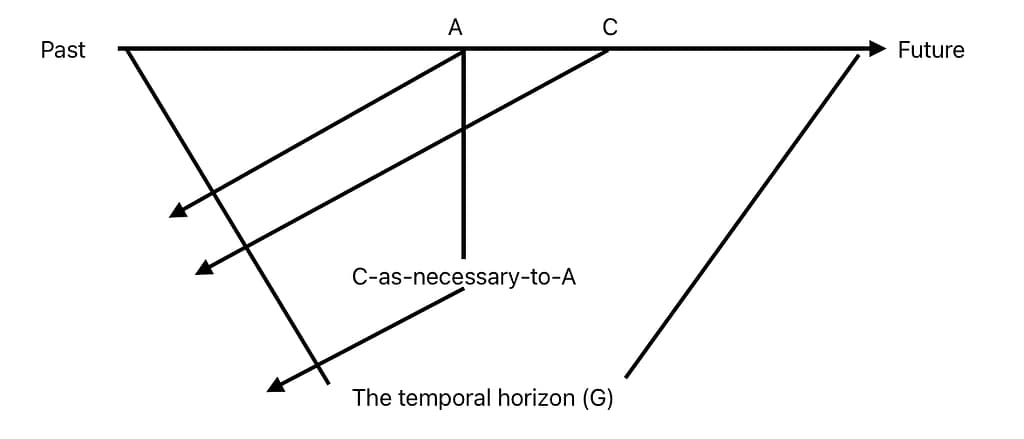
Husserl himself pioneered and drew many of these diagrams in The phenomenology of internal time consciousness. Here in my appropriation of one of these diagrams, we can identify four noematic terms in this institution, namely, A, C, C-as-necessary-to-A, and G. And the institution/founding itself is inter-categorical because in one fell swoop, both figure and ground are instituted and simultaneously perceived – the two categories we have been referring to are the foreground noematic terms, and the background horizon. Within the temporal horizon, noematic terms anticipate and protend. Once instituted, they are also retended as they recede into the past. Noematic terms synthesise into or are protended as new terms through retention. This is how C-as-necessary-to-A comes into being.
If I react against my experiences at university with a blog post, even 2 years in the making, it will be a temporal synthesis of the various intentional objects in my memory that constitutes the blog post as a totality. And the horizon is only going to persist as time, and there is nothing within this noesis/institution which qualitatively differs from actually participating in the edufactory. As sophisticated as this model might be, if we do not radicalise the insights we gain from it, we risk committing early, by resting at the point of institution, at a perpetual beginning. This I suspect Merleau-Ponty eventually did. But this needs not be, as he himself stated:
“…the essence is clearly not the goal, but rather a means; and our actual commitment in the world is precisely what must be understood and raised to the concept, and that is what polarizes all of our conceptual fixations”
p.89, Merleau-Ponty (2012)
If from Husserl to Merleau-Ponty there is a return to the originary from the eidetic, then to problematise even the originary is to move away from an exhausted how to an all-encompassing why, an existentialist why. Instead of getting strung along by wondering, “How does coping with judgment string me along?”, I pose to myself the question: “Why allow this to continue at all?” The argument, if you will, goes something like this:
A. If institution is phenomenologically necessary, then it is something-for-itself.
B. If institution is something-for-itself, then there could be nothing–for-itself.
(B) is often sidestepped by equivocating between nothing-for-itself and nothing-in-itself. That is, to replace it with:
C. If institution is something-for-itself, then there could be nothing-in-itself
(C) is a familiar form of philosophical skepticism which actually makes very little sense without dualism. To posit to oneself the additional philosophical possibility that despite everything we have described, it could all be a mere refraction, or an illusion even, of some deeper, more authentic reality which is itself unknowable, is to turn away from the phenomena which we have described, along with all the undesirable elements which make up the edufactory. Perlocutionally it is foil for actually engaging with (B).
Another common sidestepping of (B) is this:
D. If institution is something-for-itself, then there could not be nothing-in-itself
(D) is transcendental realism which unlocks the science of signification. For if reality itself is not in doubt, then the antecedent becomes the site of genuine philosophical enquiry. What is the structure of subjectivity? Of existence? Of various forms of egoic or temporal synthesis? We have already briefly talked about why by virtue of the nature of the dialectic, taking one more step does not create enough of a qualitative difference to allow one to gain any insight into what one is doing. As a philosophical approach, (D) is therefore on a different track from (B) because it remains within the dialectical framework of moving only along three phenomenological directions. It is also strictly incompatible with (B) because the transcendental subjectivity is being and not becoming. And so its absence is an impossibility, a negative space, or a lack. It is not the absence of becoming, which is the will’s active contemplate of self-annihilation, of suicide.
And so now it at least becomes conceivable why a phenomenology of motivation, of our commitment to being anchored in our own body, in this life, is not an easy thing to describe. Every time it is thematised, (B) as a realisation arises, allowing institution to travel along a fourth phenomenological direction, that of gearing-out, or de-commitment. But the dialectic does not stop simply because we realise our commitment to existence is not absolute. It remains to be described the actual phenomenal character of this realisation, how it affects the institution of phenomena, and how it positions ourselves such that the truth of the dialectic may be described for the last time. To fully develop this would take us from the scope of the present blog post. If these promises sound vague and quite implausible at present, it is only because we are at the beginning of this realisation. There is something immediately repugnant about the suggestion that contemplation of suicide should be in any way pertinent to what we have been talking about. So before we jump to moralising and instantly refuse this line of enquiry, I note a few things.
First, the various other philosophical approaches I outlined above threaten to derail us from engaging with the existential why in the same way that a dialectical edufactory censor a thetic consciousness. The mechanical appearances of both the problem of knowledge in philosophical skepticism and the problem of finitude in transcendental realism offer space for an objective retreat – always a reconstituted horizon to fall back on and begin anew. Whereas radical transformations often do not have the guarantee of safety, or a return. There is no telling what we would find, and this is because they challenge our fundamental commitment to not just things but their continuance.
Second, the existentialist why is not prescriptive. It does not create an imperative for anything, least of all to consider committing suicide or to commit actual suicide. We have no more reason to heed a crass story of discipline than we do playing protagonist in an absurd story of martyrdom. To contemplate suicide or to commit actual suicide instrumentally in order to achieve some ends would not differ from any dialectic wherein one still reasons to the contemplation of suicide or the decision to commit it. Because the existentialist why is strictly voluntary, in the sense that it is never phenomenologically necessary, to question our own existential uptake is also the only move we can truly refuse in the dialectical motion. One is not simply “forced to question,” even though without questioning, the phenomenological picture – whilst necessary – remains incomplete. The heart of the dialectic, the sense of our excess, remains obscure.
What initially inspired the thought that existence itself could be illuminated by a space in which something appearing to go on indefinitely finally could vanish is an article about a physical entity known as “anyons.” These are particles that follow a certain trajectory along 2-dimensional spaces but without a third dimension they will travel along indefinitely and be unable to complete their entropic course. There is no reason to suspect that anything remarkable is going on until an exterior becomes available. Without the extra topological dimension wherein ayons can disappear, our understanding of their original trajectories will be quite insubstantial, something which can be said, unfortunately, about attempts to “reform the edufactory from within.”

V. Resist
To dialectically reform the dialectics, without deepening our relationship with the instituted noematic terms which constitute them, is never going to be effective because the dialectics unfold with a certain velocity optimum for their continuation. Our speech within a dialectic has the potential to acquire importance, or be ignored. The phenomenology of being ignored and continuing to be ignored, bound up in this velocity, is a dialectic of fairness.
A phenomenologically unimportant act is a noetic institution or synthesis of a noametic term which enters the intersubjective world in a particular modality. The speech of the ignored person does not vanish into a power relation which functions like a black hole, instead it appears uncooperative, and always just slightly behind what has already happened, is happening and is going to happen, an eventuality. Between the ignored person and structures which are not all that interested in hearing them is a communicative latency, a situation in which both parties will “in time,” be able to fully communicate their gestures to the other. The time which subsists between one gesture and another is an eerie silence which is also dialecticised, pondered on, and narrativised.
This dynamic contains three components: (1) the velocity of the various dialectics discussed above, (2) the student’s and the assessor’s existence in between feedbacks within this dialectic, and finally (3) an overall sense of unfairness which is shared by all who are involved.
The edufactory constitutes a legible, noisy and vacuous world. Themes, creativity and ambiguity are systematically and dialectically excluded from discourse both possible and actual. But it does not do so in opposition to existentialist conditions, or violate the phenomenological necessity of noetic institution. This is what makes it so opaque and difficult to even perceive. As an arch-conservatism, a need for the world to stay exactly as it is, it does so by not only enabling, but also streamlining and fast-tracking its own dialectics. This is achieved by a total effort to carry one down only along the three phenomenological directions not involving the existentialist why. The sheer speed at which noematic terms is instituted means any self-represented disruption will be quickly folded back into the dialectics. Infrastructurally it is supported by scripts or protocols using protenional vocabulary which overwhelms retention and creates the temptation for simplexity – treating complexity disingenuously as if it were simple.
The installation of modular prerequisites, i.e., you must complete this course before you can enrol in that course, given what we have already discussed about assessments, creates not just an artificiality when it comes to actually enabling the student to fully dwell in a complex realm of underdetermined truths, but also the possibility of student planning, or accountable student-learning. I am making decisions which will “shape the course of my degree,” and university is therefore “what I make it.” But notice how there is a phenomenological gamefication of the process. I was clicking on icons on the enrolment system, reading course descriptions, imaging “what it would be like,” or “how nice it might be,” to learn about what I thought the thing taught would be. Like a player assigning skills points in a top-down, isometric, computer role-playing game, I do not actually puppeteer the limbs and control the movement of my avatar, I simply assign weights within a certain conceptual scheme with a certain ontology comprised of a sum total of possible interactions and feel satisfaction vicariously through the experiencing of a simulated outcome. I do not get a chance to say, “Hold on a minute!” before four months passed me by and I was already supposed to have “learnt about” and “acquired a grounded understanding” of various topics in, say, aesthetics. Any second thoughts about this self-representation will be smoothed over as lecturers acknowledge competence only by referencing units which were previously completed, speaking about them in terms of something-you-ought-to-have-done-before-coming-to-me, instead of particular manners of organising and interacting with the world symbolised as a particular discipline, or a field of knowledge. The former is something the student can, within a pre-determined timescale, have; it is also something that the lecturer can easily respond to, or refuse, by for instance failing a student and forcing her to resit the module. Meanwhile, the latter takes a lifetime to cultivate, its existence is continuous with the student. This efficiency makes it inferior.
The time for rumination, speculation and meaning sedimentation is also replaced by the time spent managing the sheer number of “options” open to the student within the dialectic. Often these do not serve to actualise autonomy, but to pre-empt charges of dehumanisation. Options are there to make things easier for you, you just did not take advantage of them. But the invisible (and hence unchallenged) term in this institution is the very task which the student is being asked to perform alongside these options. Options facilitating something which has yet to pass through the student’s experience and achieve authentication as such are mere distractions. Effectively, they crowd out the student’s phenomenal reality, as the institution of noematic terms becomes a frequent and “mind-numbing” phenomenon that synthesis of these terms into insight becomes impossible. Students dissatisfied with the limitations of classroom discussions can seek out student societies, except the administration of student societies is so regimented, the set-up requiring so much administrative effort (submitting forms, managing deadlines, drafting constitutions) that most students will probably save themselves the headache by passively joining pre-existing societies instead of forming them. Once formed, these societies become items on a semester calendar, and occasions which take place in lifeless, dismal teaching spaces recalling all the anxieties of lectures and assignments. Meanwhile, real spaces where communities could form become liminal. Cafeterias, corridors, libraries – easy to access and high footfall areas – become places where students either walk past or retreat into their own private worlds. There was a reason why the rent strikes and the encampment of students in protestation of the University of Manchester’s affiliation with arms sales to Israel took place on the university green. This was a public space, and anyone from within and without the university could join in to show solidarity. A gradual, fomented and threshold event like a student protest does not figure so easily in a stream of options. It does not overwhelm the senses making it difficult to raise the existentialist why. It erupts because the existentialist why has already been raised.
This brings me to Peer Mentoring.
Being already quite dissatisfied with the general way my education had been going, I decided to get more involved in the administrative side of things by volunteering myself as a Peer Mentor. It was going to be an entry point into “student politics,” a concept I detested at the time but felt like the only way for me to get out of the rut which I felt stuck in. To the faculty, I proposed a more varied approach to assessment (e.g., incorporating group projects, presentations, etc.). I dropped in lectures to advertise student surveys, sat myself in common areas hoping opinionated students would start showing up and sharing with me what they thought we could do as a community to “make ourselves heard.” But the longer this went on, the more disheartened I was by the feedback I received. Any suggested changes to the examination format were quickly deflected with “accessibility concerns.” Students did not participate in the surveys, and rarely showed up to any of the walk-in sessions. I realised I was effectively competing with the sheer volume and accessibility of structures that the university had already put in place. My efforts were made redundant, running out of space, before they even had a chance to begin. They were transient moments in the dialectic of fairness, as incapable of leaving behind a legacy as the edufactory is incapable of remembering its students. On the level of eventualities, or an absence for radical change, the university’s ability take account of them far outstripped my own. In my world, the possibility that an organic student philosophical community might be formed, thereby decentring the university discourse, was still naively held. But to those who were all too happy to “take advantage” of these eventualities, to say to informal student communities “What’s the point?”, efforts like mine must come across as just too late, but also entirely antithetical to the overall agenda or progression of the student experience. Like a petulant infant kicking its feet, these efforts can easily be dismissed as me wanting something I am not getting, and if all I wanted was a fairer marking, appeals process were already in place, assessors also had office hours. Optionality, as something which always precedes the imagination, characterises the dialectic of fairness as one about individual responsibility, successes and failures in the exercises of these options.
Absent any class solidarity, the good student is an estranged existence. It exists in between the noematic terms which enter consciousness in a constant stream of never-ending options. To the good student, the distinct sense is that a decision needs to be made, and not that a decision is needed to be made. But before we turn towards condemning the good student, I believe the world of every good student shares with the world of a neglected child certain structural features. Throwing oneself into the dialectic does not thereby exempt one from its pernicious effects. Phenomenological importance is not intuited simply by virtue of one’s continuous motion.
The good student is ignored qua a solipsism. The edufactory becomes a paracosm, a fundamentally imaginary set of rules and protocols that were enabled by the dialectic but once instituted fix the good student in place in highly individual-specific ways. Narnia was inspired by real life locations but it is not any of them. It has its own geography, physics and morality. The Foucauldian duality of discipline, a discourse of knowledge which presents itself as both an object and an objective, thereby functioning both as a body of norms and as a tool for fixing bodies in their respective places, rears its head. In such a world, the good student is an abstract and presiding intellect that decides for itself what to do, how to be good and which feedback to take onboard and which ones to discard. It is beautiful in its own way, for it also allow the good student to live as a hero of an story untold, a maker of decisions with no real consequences. Its existence is as an ideal, a construct of a construct – a self-enclosed, formal and empty Hegelian subjectivity. As Barbara Grant so meticulously described it in Disciplining Students – The Construction of Student Subjectivities:
“Excluded from any social position he might occupy…this individual is hailed as the basic social unit in which freedom and rationality are located. His nature is seen to be inherently good or at least, malleable and, as the ‘sole author of his own beliefs and customs’…his rationality is privileged as ‘the real basis of authority for regulating the affairs of daily life’…His increasing knowledge about the world is assumed to be the crux of change which is ineluctably progressive. From this common-sense perspective, students are in their very nature autonomous, rational, thinking individuals and the function of a university education is, as Newman contended, to improve on this untrue. In addition to this nature, the personal qualities which are explicitly encouraged, indeed, produced, within the university system are those of competitiveness and independence (in so far as the student is responsible for her or his own success), a fierce kind of individuality in which the strong survive and the weak fall by the wayside.”
p.102, Grant (1997)
To cultivate a good student then, is to develop individuals who cannot move an inch away from their self-representations as being a strategic actor, even though the strategy of this immobility is entirely forgotten or erased. This disinterest and emotional neutrality is in turn represented as a kind of grit, or competitive edge, the possession of which becomes the good student’s own reward, even though these qualities are rarely rewarded. For one, the ability to “bite the bullet” consists precisely in the ability to demand no reward for one’s labour. And when students are busy out-competing with one another, there is hardly any time for mutual recognition, for individuals to see the good student in one another, except through the eyes of envy. The successes of this cultivation are apparent. In Canaan (2004) we see how students consciously represented to themselves as having benefitted from systemic, drip-fed recognitions offered in assessment feedbacks even though there was evidence manifestly contradicting their perceived role within a perceived meritocracy. In Iannone & Simpson (2017) we see students defining fairness as “the potential of the assessment…to account for individual differences,” and some were more interested in eliminating opportunities to gain marks unfairly than they were in enhancing opportunities to gain marks fairly (pp.8-13, Ibid.).
Deprived of the social, the good student is a lonely creature who does not have to be. He toils while constantly wondering, “When will it be my turn? To be recognised for the work that I do?” The unfairness which results in the systemic disempowerment of reform attempts, also creates a phenomenological latency between an actual demand for a fair recognition, and the pure possibility of ever more work on the horizon. In short, even to the good student, the answer to “When will it be my turn?” is meant to be constantly asked and never answered. The ethics of work precedes the sense of unfairness, which is destined for even more work. Students will continue to be asked to crunch organic expressions of themselves into daguerreotypes of the mind (Elwick 2022). Assessors – repeating the phenomenal acts of the good student – will continue to be paid just enough to spend 20 minutes maximum skimming over student essays wondering if they will ever, on the other side of the hill, attain a permanent position, or be able to move on to more exciting work such as research. Unfairness, which should be the most demotivating of all phenomena, instead functions as an originary motivation that structures the edufactory as a perennial work-in-progress which apportions fairness like some scarce commodity.
Whether passed down from above, or self-inflicted, once we allow the dialectic of fairness to present us with a trade off between the right to have (options, reward) and the right to be treated well (by being given phenomenological importance), suddenly the temptation arises to treat the attainment of the former as paramount. The unfairness which inheres in being continuously ignored is therefore constitutive as an underbelly of an estranged existence. This is like the example in Elwick (2022), where Victorian-era feminists sought to legitimise female social participation via promoting their commensurability in public exams. The logic then being: If girls were evaluated as having the same capabilities as boys, then the questions of whether the exams themselves were flattening could wait. Better to be recognised than not. But expectedly, even when girls began to outperform boys, various misogynistic narratives were still being perpetrated, e.g., the narrative that these high-achieving women must have “freakishly strong constitutions” (p.188, Elwick 2022). The locus of misrecognition simply shifts, from not seeing women to not seeing proper women. Similarly, we sometimes encounter the liberal argument that universities must be run like an edufactory because the alternative would be radically aristocratic and downsized departments, a one-way train to wholesale illiteracy. What this argument achieves in effect is what Jennifer Bloomer called a series of “Not Now”s, a silencing of voices for reforms or marginalised opinions by the categorical claim that it is always more important to keep or to preserve what is “fundamentally a good thing”. Like what Foucault observed about reforms of penal apparatus, the ontology of the edufactory is the ontology of reforms. Reforms, embodied in the presentation and exercise of ever-more options within the system, or the striving to attain ever-taller positions of individuals relative to their peers, are programmatic of a unique dialectic of fairness in the edufactory which has already attained its perfection by being a reformable-but-never-fair structure.
In some situations, the assessor can join in with the student in solidarity. However, the opportunities for dialogue or interaction are simply not there for students to coordinate with assessors in instituting a radical pragmatics of assessment. Then there is the “extensive work by the self on the self,” or “a readiness to accept the possible consequences such as implications on career and future studies or even a dismissal” (p.168, Raaper 2016) which seems to present an insurmountable psychological and economic barrier for assessors to fully play their part in radically reconstituting the way knowledge is currently passed down and assessed. My hunch is that assessors are confronted with a similar dialectic of fairness which seals them off from the complex social world of people arriving to listen and to grow. They too are being ignored continuously, and they too suffer in a panoptic blindness characteristic of the good student.

VI. Conclusion
And this is where I conclude the first part of my thoughts on the matter. Before I leave my thoughts to you, where they will find verification, I recall the three questions I set myself at the very beginning of the post:
(1) How does coping with judgment string us along? And,
(2) how do we become aware of the edufactory from within – that is, how does coping connect with a totality? And finally,
(3) what do I do in the face of this? How does my critique of the system move beyond merely labelling it, disparagingly and unflatteringly?
The more I write, the more I realise that the three questions overlap in more ways than I had initially anticipated. For example, the existentialist why, which has only so far far been given a broad, unsubstantiated description, appears to be the key to answering questions (2) and (3). There are also other “loose ends” which I am aware could lead to more being said.
In the face of all these lacunae, I was tempted to dive straight back in. But as I strayed farther and farther from the canopy of my research, I found myself in ever-greater need for intellectual nourishment. In short, I think I will stop writing now.
Leave a Reply